Building a Credible GHG Inventory: A Guide to Quality, Reductions, and Reporting
2026-01-22 · By Anil Kancharla · 4 min read
❤️ 0 Likes · 👁️ 0 Views
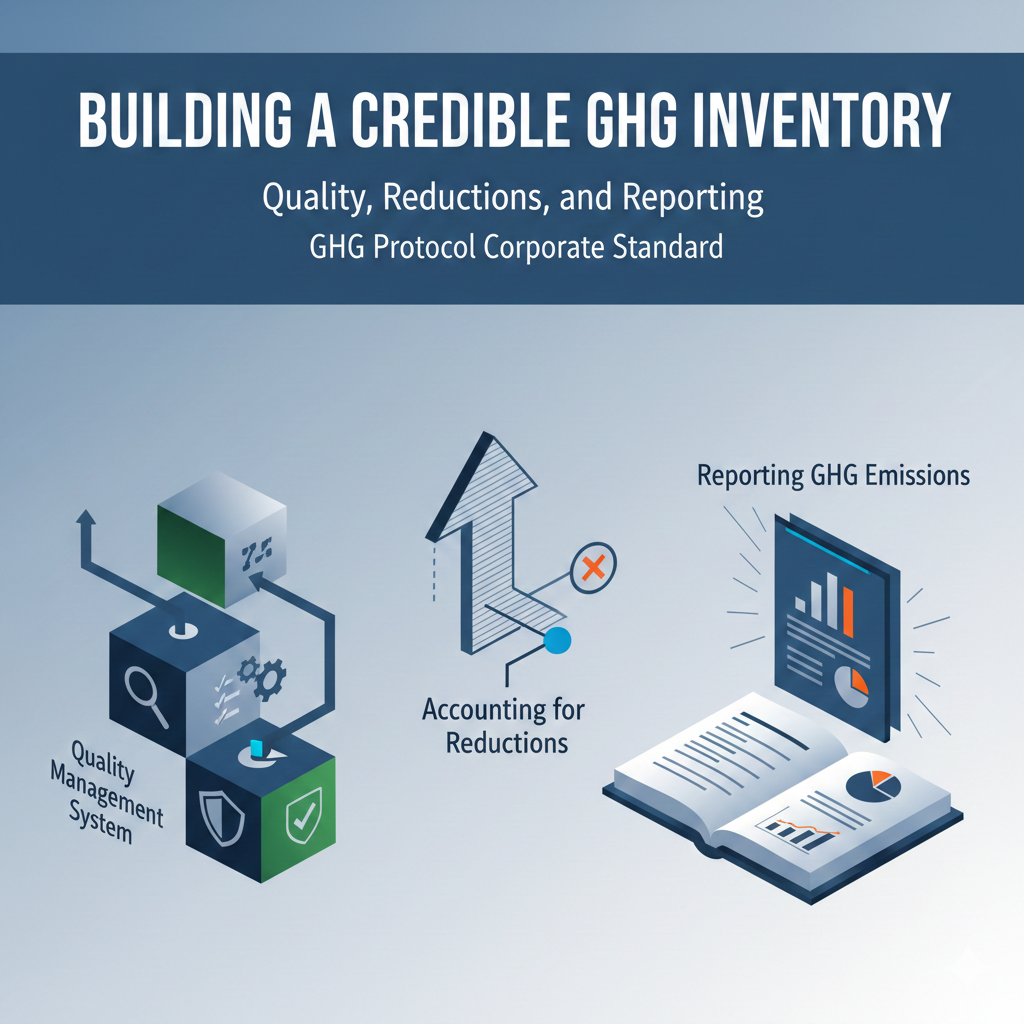 AI-generated image for illustration purposes only.
Building a Credible GHG Inventory: A Guide to Quality, Reductions, and Reporting
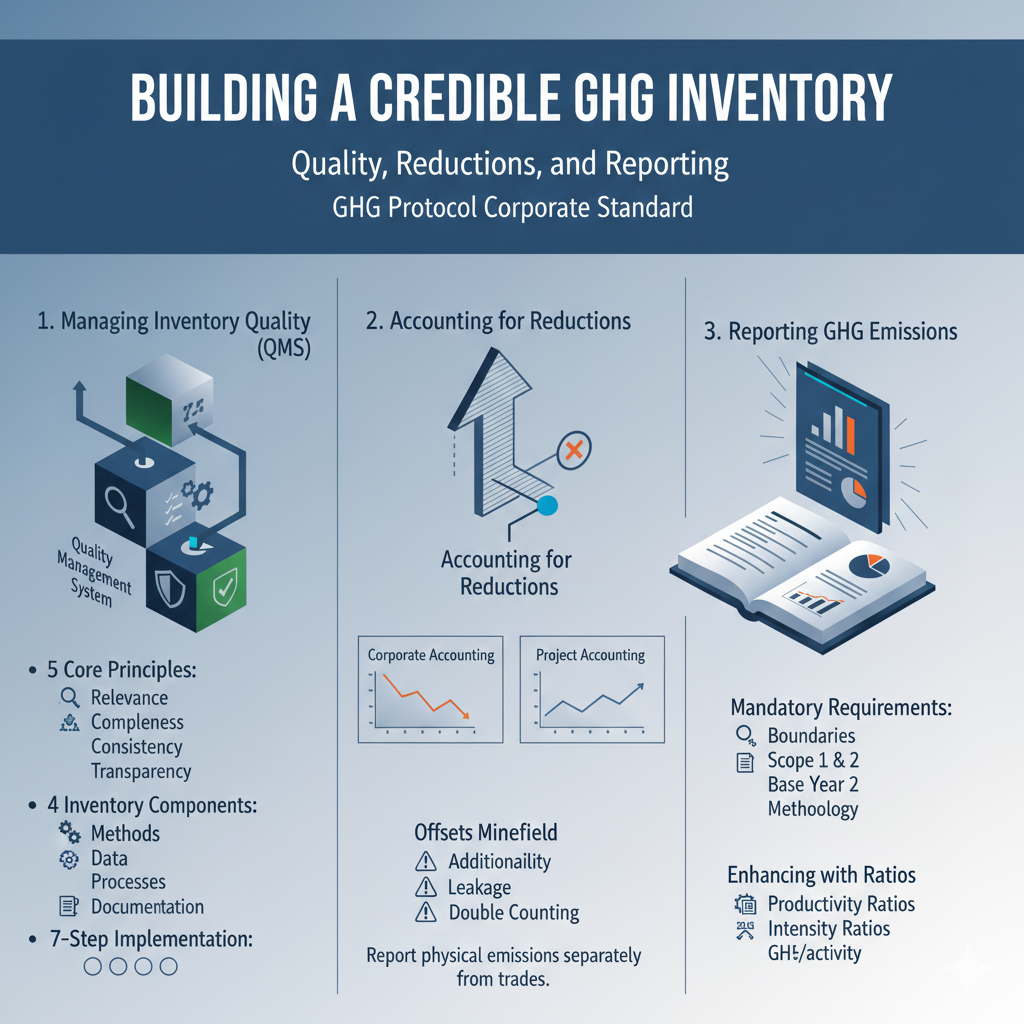 AI-generated image for illustration purposes only.
Building a Credible GHG Inventory: A Guide to Quality, Reductions, and Reporting
In the push for corporate transparency, a greenhouse gas (GHG) inventory is more than just a spreadsheet of numbers—it is a statement of accountability. However, for that statement to hold weight with stakeholders, it must be built on a foundation of data integrity.
Drawing from the GHG Protocol Corporate Standard, we explore the essential frameworks for managing inventory quality, accounting for reductions, and professional reporting.
1. Managing Inventory Quality (QMS)
The goal of a Quality Management System (QMS) is to ensure your inventory is a faithful, true, and fair account of your company’s footprint. Quality isn't just about "being right"; it’s about adhering to five core principles: Relevance, Completeness, Consistency, Transparency, and Accuracy.
The Four Pillars of an Inventory Program
To build a high-quality inventory, companies must focus on these four components:
- Methods: The technical formulas used to estimate emissions.
- Data: The lifeblood of the report. Remember: Data quality is more important than methodology. No complex math can fix poor input data.
- Processes: The "how-to" of your inventory preparation.
- Documentation: The paper trail that ensures your estimates are verifiable.
Implementing the 7-Step Quality Process
Implementing a QMS doesn't happen overnight. It follows a logical progression:
- Team Up: Establish a dedicated quality team.
- Plan: Create a QMS plan during the initial design phase.
- General Checks: Verify basic data handling and calculations.
- Specific Checks: Deep dives into high-impact emission sources.
- Review: Conduct technical and managerial internal audits.
- Feedback: Create loops to fix errors and improve for next year.
- Archive: Formally document and store records for external stakeholders.
2. Accounting for Reductions: Corporate vs. Project
Understanding the difference between corporate-level and project-level accounting is vital for preventing greenwashing.
- Corporate Accounting: Measures the actual change in your total emissions over time compared to a historical base year.
- Project-Based Accounting: Measures reductions against a hypothetical baseline (what would have happened if the project didn't exist).
Navigating the "Offset" Minefield
If your company uses offsets to claim reductions, you must address four critical risks:
- Additionality: Would this reduction have happened anyway without the project's funding?
- Leakage: Does your project cause emissions to increase somewhere else?
- Reversibility: Could your stored carbon (like a forest) be lost to fire or logging later?
- Double Counting: Is another entity claiming the same credit?
Pro Tip: Always report your physical emissions separately from any GHG trades or offsets. This ensures transparency in your actual environmental impact.
3. Reporting Your GHG Emissions
A credible report is the final product of your hard work. According to Chapter 9 of the GHG Protocol, certain disclosures are mandatory for a report to be "in accordance" with the standard.
Mandatory Requirements
- Boundaries: Clearly defined organizational and operational limits.
- Scope 1 & 2: Total emissions for both, reported separately for each of the six Kyoto gases.
- Base Year: A clear historical reference point and emissions profile over time.
- Methodology: Transparent explanations of calculation tools and any exclusions.
Enhancing Your Report with Ratios
While absolute emissions are required, Ratio Indicators provide necessary context for your business growth:
- Productivity Ratios: Value created (e.g., revenue) divided by GHG impact.
- Intensity Ratios: GHG impact per unit of activity (e.g., tonnes of per product created).
Summary
Managing a GHG inventory is a continuous journey of improvement. By institutionalizing a QMS, clearly distinguishing between actual reductions and offsets, and reporting with radical transparency, your company can move beyond "compliance" and toward genuine climate leadership.
💌 Enjoyed this article?
If you found this post valuable, subscribe to my newsletter for more insights on digital transformation, AI, and business innovation.
👉 Subscribe to the newsletterOr let’s connect on LinkedIn — I share weekly content that’s practical for CIOs, CFOs, and transformation leaders.
🔗 Connect with me on LinkedIn